Now live on orbitforge.dev

AI release control for serious software teams

OrbitForge mark

OrbitForge

Lifecycle-first AI coding

OrbitForge turns AI coding from a prompt gamble into a controlled product workflow.

Most coding tools help generate code. OrbitForge helps teams ship work that is scoped correctly, evidence-backed, resilient across providers, and ready to survive a public release.

Execution lanes

6 providers

Shipping surfaces

Web, CLI, desktop, VS Code

Release safeguards

13 intelligence systems

Ecosystem surface

No-code lifecycle studio

Hosting target

Vercel Hobby + custom domain

Live operating model

Release cockpit

Ready to ship

Live OrbitForge workbench

The actual product surface, not a mock hero.

How It Works
OrbitForge workbench screenshot

Mission

Prompt, context, and proof stay visible.

Control

Providers, workflows, and recovery lanes are built in.

Proof

Snapshots, gates, and release outputs are captured in one place.

Mission lock

Launch OrbitForge on orbitforge.dev with docs, downloads, and proof that match the product.

Non-goals

No private localhost dependencies. No vague launch copy. No broken release story between pages.

Proof required

Build passes, routes render, domain resolves, and the product story matches what actually ships.

Gate

89

Readiness score with provider, route, and release checks in place.

Jury

3 lanes

Primary model, fallback, and second opinion before a risky change is accepted.

Recovery

Auto-heal

Fallback routing keeps the run moving when a provider or model fails.

Why teams switch

See plans

Native Ollama support

OrbitForge

Yes

LM Studio preset

OrbitForge

Yes

Release checklist and launch pack

OrbitForge

Yes

Website, docs, pricing, downloads in one surface

OrbitForge

Yes

Provider and surface coverage

One product surface across local models, hosted models, desktop packaging, and editor workflows.

OrbitForge is designed to keep the website, workbench, CLI, desktop app, and VS Code extension aligned instead of making every surface feel like a different product.

OrbitForge Demo

Hosted

Zero-config built-in execution lane for the hosted product

orbitforge-analystorbitforge-criticorbitforge-shipper

Ollama

Local first

Best for private local coding sessions

deepseek-coder:33bqwen2.5-coder:32bcodellama:34b

LM Studio

Local first

Desktop-hosted OpenAI-compatible endpoint

local-modeldeepseek-coderqwen-coder

OpenAI

Hosted

Cloud frontier models for coding and reasoning

gpt-4.1gpt-4oo4-mini

Anthropic

Hosted

Claude-family models for long-horizon coding tasks

claude-sonnet-4-5claude-opus-4-1

OpenRouter

Hosted

Broker multiple hosted models behind one endpoint

anthropic/claude-sonnet-4openai/gpt-4.1google/gemini-2.0-flash

macOS

DMG + ZIP for desktop, VSIX for editor, TGZ for CLI

Local-first builders using Ollama, LM Studio, and desktop packaging.

Hosted web appDesktop appCLIVS Code extension

Windows

NSIS + ZIP for desktop, VSIX for editor, TGZ for CLI

Teams standardizing PowerShell, enterprise laptops, and shared rollout rules.

Hosted web appDesktop appCLIVS Code extension

Linux

AppImage + tar.gz for desktop, TGZ for CLI

CI pipelines, self-hosted coding flows, and local model infrastructure.

Hosted web appDesktop appCLI

The pain OrbitForge actually solves

The hard part is not generating code. The hard part is shipping the right thing with proof.

These systems exist because teams lose time to hidden contradictions, weak proof, silent intent drift, and release workflows that live only in someone's head.

Model Jury

Teams waste time betting on one model without seeing disagreement or confidence gaps.

What changes

Run multiple models on the same task and inspect divergence before committing to a path.

How OrbitForge implements it

A first-class jury route plus a workbench panel that compares ballots, latency, and synthesis.

Mission Lock

The biggest hidden failure in AI coding is silent intent drift: the original non-negotiables disappear as soon as the workflow gets iterative.

What changes

Lock the north star, immutable constraints, non-goals, and proof requirements before generation so the system cannot quietly drift away from the real assignment.

How OrbitForge implements it

A mission-lock engine that derives non-negotiables and proof requirements from the prompt, workspace, release contract, and blast radius.

Proof Gate

Humans often accept polished answers that sound done even when no proof was provided.

What changes

Score whether the output is evidence-backed, flag unsupported completion claims, and show exactly what proof is still missing.

How OrbitForge implements it

An output trust gate that compares generated answers against the locked mission and required proof requirements.

Release Gate Preflight

Most AI coding tools let risky runs start before teams know whether auth, context, or validation plans are actually ready.

What changes

Score readiness before generation, block unsafe runs, and recommend the next best action for high-risk work.

How OrbitForge implements it

A preflight API and UI gate that evaluates provider readiness, workspace coverage, release risk, jury recommendations, and fallback playbooks.

Hidden Pain Detector

Humans often blame the model when the real issue is an unstated contradiction, a missing surface owner, or a release task with no proof expectations.

What changes

Expose invisible coordination costs, missing inputs, and contradiction-heavy prompts before they create bad output.

How OrbitForge implements it

A hidden-pain analysis layer that scores operator burden and surfaces faultlines, invisible costs, and missing inputs in the workbench.

Auto-Heal Recovery Lanes

Provider failures usually force the human to become the recovery orchestrator.

What changes

Prepare fallback execution lanes and recover from auth, network, missing-model, or compatibility failures with less manual intervention.

How OrbitForge implements it

Recovery-lane planning in preflight plus sequential fallback attempts in the chat route when recoverable errors appear.

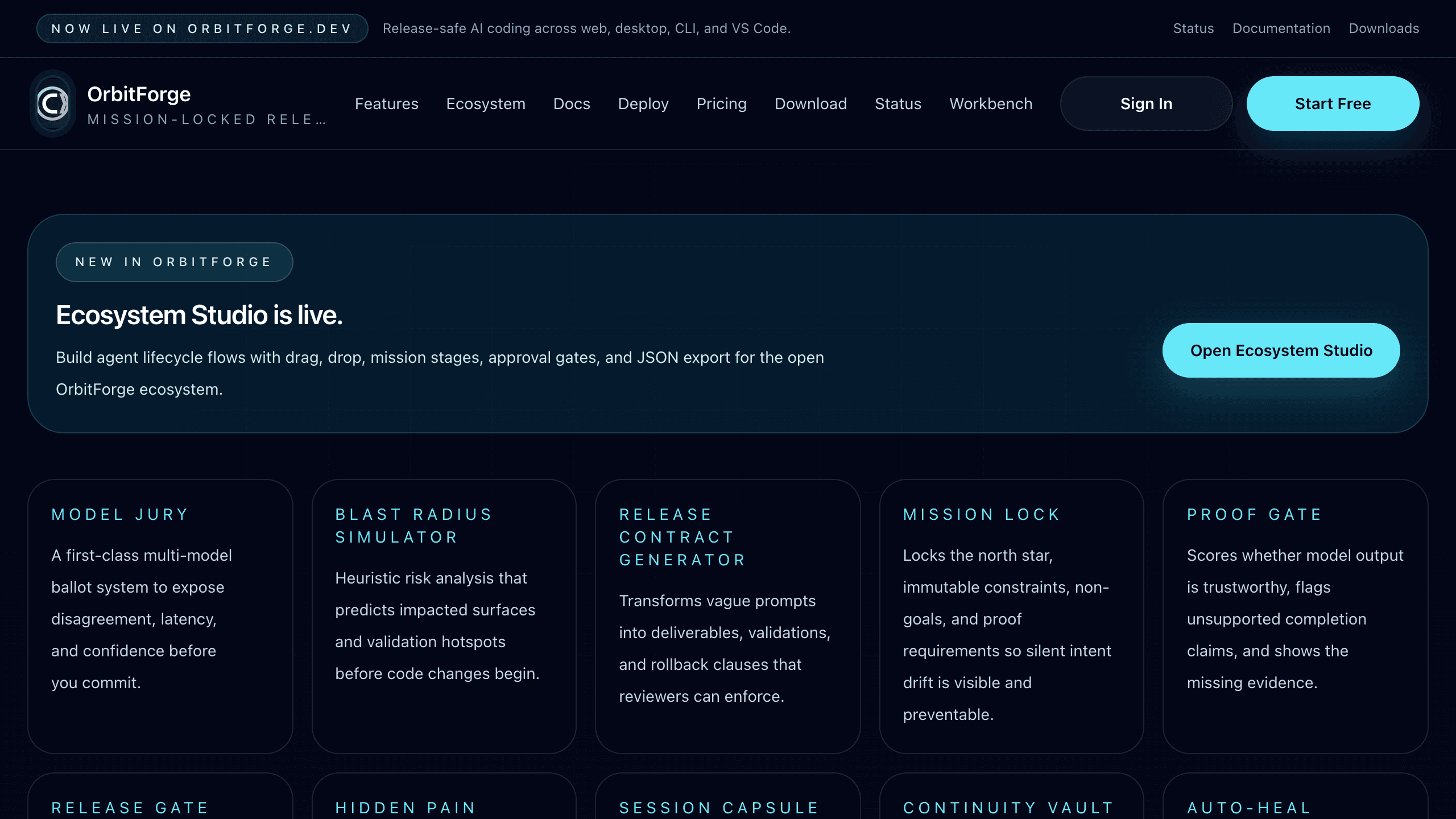
How the product behaves

A release control loop, not a chat window pretending to be a workflow.

OrbitForge is built around the operational moments that break most AI coding sessions: weak setup, hidden risk, and broken continuity when conditions change.

01

Lock the assignment before generation starts

OrbitForge captures non-negotiables, proof requirements, and non-goals so the system cannot quietly drift into a different task.

02

Compare risky decisions instead of trusting one answer

Model Jury, Blast Radius, and Release Contract work together to surface disagreement, breakage risk, and validation expectations before a patch lands.

03

Recover without losing context or release posture

Session Capsule, Continuity Vault, and Auto-Heal Recovery keep work moving when providers fail, laptops reset, or teams switch surfaces.

Signature systems

The product story is built around release intelligence, not another model picker.

Explore all features

Model Jury

Compare multiple model ballots on the same task before a risky implementation lands.

Blast Radius Simulator

Estimate what a change touches, how risky it is, and where verification effort should go.

Release Contract + Ship Memo

Turn prompts into explicit acceptance criteria and public-facing rollout notes in the same session.

Mission Lock + Proof Gate

Freeze non-negotiables and verify that outputs are evidence-backed instead of only sounding complete.

Release Gate Preflight

Score readiness, catch missing credentials or weak workspace context, and stop unsafe runs before they start.

Hidden Pain Detector

Expose contradictions, unstated assumptions, and invisible coordination costs that humans usually carry in their heads.

Session Capsule + Auto-Heal

Resume the same run across surfaces and recover from provider failures without manually rebuilding context.

Freshness Sentinel + Continuity Vault

Catch stale dependency advice and keep automatic snapshots so progress survives crashes or tool switches.

Ready for launch

Use OrbitForge when the cost of being confidently wrong is higher than the cost of doing real release work.

The app, docs, deployment flow, pricing story, download narrative, and status surface are already wired together. You are not stitching together five separate prototypes and calling it a product.

For founders and product engineers

Ship quickly without giving up proof, rollback language, or cross-surface consistency.

For platform and enterprise teams

Standardize how AI coding work is initiated, reviewed, recovered, and released across teams.